Start with the product, then choose the market. Yiwu suits broad assortments of small goods; Guangzhou is a useful starting point for apparel and accessories; Shenzhen's Huaqiangbei is associated with electronics. For furniture, compare Foshan's Lecong area; for fabrics, consider Keqiao in Shaoxing. A custom product may call for a factory visit rather than a general market trip.
China's wholesale markets are not interchangeable, and a market stall is not automatically a factory. This guide separates markets, showrooms, and manufacturing clusters, then gives you a practical way to compare offers during a visit.
Which China wholesale market fits your product?
| Product or buying task | Place to investigate | Type of sourcing environment | First detail to verify |
|---|---|---|---|
| Mixed small goods, gifts, and accessories | Yiwu International Trade Market | Large market organized by product categories | Correct district, shop, and minimum per style |
| Apparel and fashion accessories | Guangzhou's garment and accessory markets | Several separate market areas and specialist buildings | Current stock, size ratios, and reorder availability |
| Electronics and components | Huaqiangbei, Shenzhen | Electronics trading district with multiple buildings | Exact model, condition, and test specification |
| Furniture | Lecong, Foshan | Furniture showrooms and trading businesses | Materials, dimensions, packing, and shipping volume |
| Fabrics | China Textile City, Keqiao, Shaoxing | Textile market and related suppliers | Composition, usable width, weight, and dye-lot consistency |
| Toys | Chenghai, Shantou | Toy manufacturing cluster and showrooms | Actual producer and documentation for your exact item |
| Garments and sportswear supply | Shishi, Fujian | Garment markets and manufacturing network | Stock order versus a new production run |
| Lighting | Guzhen, Zhongshan | Lighting markets, showrooms, and manufacturing cluster | Electrical specification, components, and intended market |
| A product with fixed custom specifications | A shortlisted factory in the relevant cluster | Production site visit by arrangement | Whether the facility can make the agreed specification |
These are places to investigate, not guarantees that every business there fits the category or exports directly. Confirm the current building, address, opening arrangements, and supplier appointments before booking a trip.
1. Yiwu International Trade Market: mixed small goods
Yiwu is useful when you need to compare a wide assortment of gifts, accessories, household items, and other small goods. Research categories before arriving so you do not spend the visit walking between unrelated sections.
The market operator's directory places toys and jewelry among District 1's categories, and bags and small appliances among District 2's. Use the current directory to locate the particular category and shop, rather than assuming an old floor map is still accurate. Chinagoods publishes market and category information.
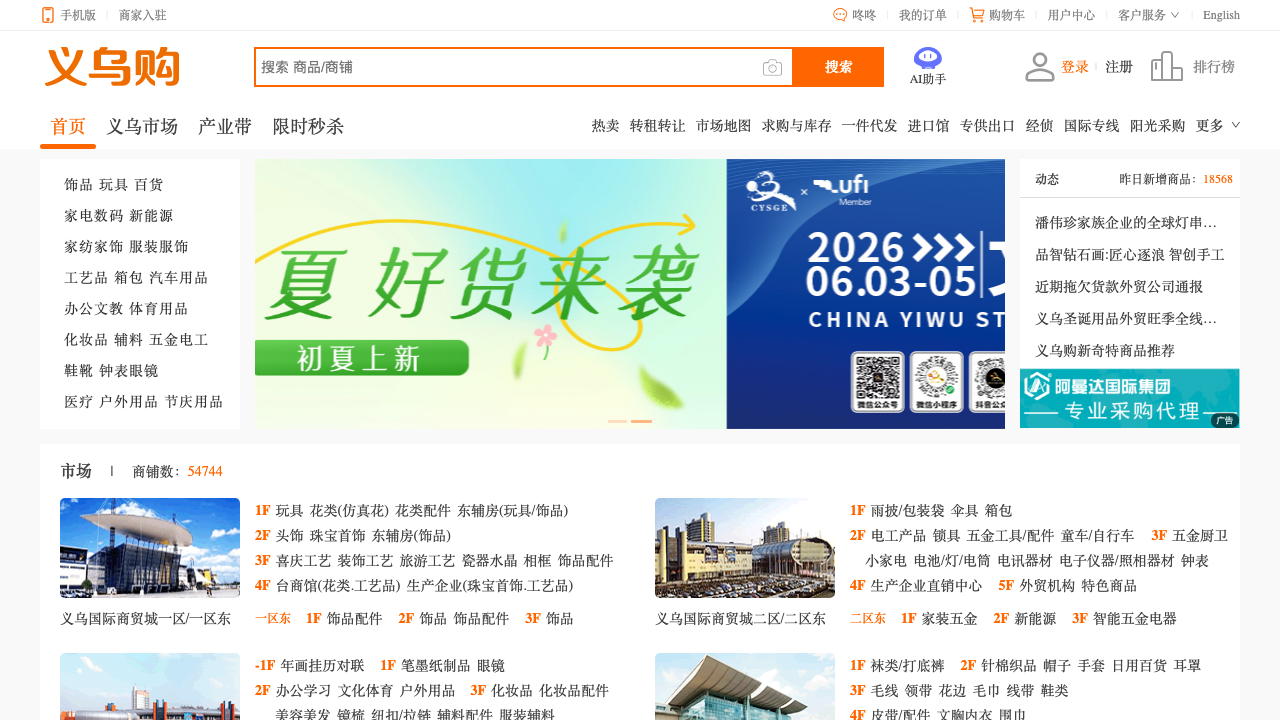
At each shop, ask whether the product is in stock, made to order, or sourced from another manufacturer. Confirm the minimum per model and color, the carton quantity, and whether a repeat order can match the sample. Mixed small orders also need a clear receiving and consolidation plan. Read the Yiwu market guide for more detail.
2. Guangzhou: choose the market by apparel category
“Guangzhou wholesale market” describes many separate places. A garment market, a bag market, and a fabric district do not serve the same buying task. Areas such as Baima and Shahe are starting points for garment research; confirm the individual building and category before visiting.
Take measurements and a target specification, not just inspiration photos. For ready-made garments, check whether the price requires a size run or a minimum quantity per color. Ask whether the styles are repeatable stock or a one-off assortment.
For private-label production, identify who owns the pattern, who will manufacture, and whether your sample represents the proposed production method. A shop visit can help you choose styles; a separate factory assessment may still be appropriate.
3. Huaqiangbei, Shenzhen: define the electronics precisely
Huaqiangbei is an electronics trading district, not one building or a single supplier. Shops may specialize in components, accessories, finished products, or other parts of the electronics trade. Plan around your exact category.
Write down the model, component specification, condition, accessories, and required tests. “The same as this photo” is not a sufficient specification for electronics. Where condition matters, distinguish new, used, refurbished, and replacement parts explicitly in the order.
Arrange a practical sample test and ask whether the production or supply batch will match it. Check the documentation for the actual product and intended destination, and confirm whether batteries or other features affect the shipping route. The Huaqiangbei electronics guide covers the category in more detail.
4. Lecong, Foshan: furniture needs a packing and delivery plan
Lecong is a useful starting point for furniture showroom comparisons. Seeing materials, finishes, cushions, joints, and dimensions in person can reveal differences that photographs hide.
Record the material specification for the item being quoted. A similar appearance does not mean identical wood, board, upholstery, hardware, or internal construction. Confirm whether the displayed sample and your order use the same specification.
Before comparing delivered cost, request packed dimensions, gross weight, carton count, and protective packing details. Agree how damage will be documented and remedied. For a mixed shipment, identify who checks every item and prepares an accurate packing list before the container or consolidated load leaves.
5. Keqiao, Shaoxing: fabrics need measurable specifications
China Textile City in Keqiao is a starting point for fabric sourcing. Bring reference swatches and a written brief covering composition, usable width, weight, finish, color, and intended use.
Distinguish ready stock from fabric that needs weaving, knitting, dyeing, printing, or finishing. Ask whether the minimum is per color, pattern, or production lot. A price per meter is not comparable until the width and other specifications match.
Agree how color approval, shrinkage, and other relevant performance checks will be handled. Keep an approved reference and record the lot details for repeat orders; a small swatch does not establish consistency across all rolls.
6. Chenghai, Shantou: treat it as a toy sourcing cluster
Chenghai is a toy manufacturing and trading cluster rather than one universal “toy market.” A productive visit may involve showrooms, trading companies, and shortlisted factories.
Identify the manufacturer of the exact item, then request documentation that matches the model and intended market. A test report for a different toy or material is not interchangeable with evidence for your product.
Confirm age grading, components, packaging, instructions, and any batteries or accessories in the supplied set. For customization, establish who owns the tooling and artwork and what changes require a new sample or further testing.
7. Shishi: separate garment stock from manufacturing orders
Shishi is worth investigating for garment sourcing and the surrounding manufacturing network. As elsewhere, a market offer for available stock is different from a factory offer to produce a new collection.
For stock, check size and color ratios, condition, branding, and replenishment. For production, define fabric, measurements, construction, labels, packaging, and the approved sample. Ask which steps are performed by the contracting business and which are subcontracted.
8. Guzhen, Zhongshan: lighting requires an exact configuration
Guzhen is a specialist lighting sourcing location. Compare the electrical and mechanical specification behind the design, including voltage, driver, lamp or LED configuration, mounting, materials, and packaging where relevant.
Ask for documentation tied to the proposed model and target market. A showroom display and a general certificate do not establish that every configuration on offer meets the same requirements. Confirm replacement components and how damage or early failures will be addressed.
What about Shanghai wholesale markets?
Shanghai can be useful when a specific supplier, showroom, or trade event is there. It is less useful to plan a trip around a generic phrase such as “Shanghai wholesale market place” without a product category and named destination.
Start with the businesses you need to meet, then confirm their location and whether they can show relevant products or production. If your main goal is small goods, textiles, furniture, or electronics, compare the specialist locations above before choosing a base. Our China sourcing cities guide provides a broader category map.
Use one comparison sheet at every shop
Prepare the same questions before the visit. Record the shop number and contact details alongside each sample photo so you can connect the product to the offer later. Ask permission before photographing products or facilities.
| Record | Questions to ask |
|---|---|
| Business identity | What is the legal company name, and is this a manufacturer or trader? |
| Product and sample | Which exact model, material, size, and finish does the quote cover? |
| Quantity | What is the minimum per design, color, size, and carton? |
| Availability | Is this current stock or a production order? When can it be ready? |
| Price scope | What currency and delivery point apply? Which charges are separate? |
| Payment | Which company receives payment, and what are the agreed milestones? |
| Quality checks | Who approves the sample and checks the goods before dispatch? |
| Packing and logistics | What are the packed dimensions and weights, and who consolidates? |
| Problems and reorders | What remedy is agreed for defects, and can a repeat order match? |
For example, when comparing two bag suppliers, use the same fabric, lining, zipper, dimensions, and packaging requirement. This is an illustrative comparison method: a cheaper bag with different construction is a different offer, not evidence that one market is cheaper.
Market visit or factory direct?
Choose a market when you need to explore styles, compare physical samples, or build a mixed assortment. Consider a factory visit when the product is already specified and production capability, customization, or repeat consistency is the main question.
| Your next decision | A useful next step |
|---|---|
| Which designs should I carry? | Compare market samples and test a limited assortment |
| Can this custom specification be produced? | Review a relevant factory and develop an approved sample |
| Can this supplier repeat the same quality? | Review production controls and agree an inspection plan |
| Can several shops ship together economically? | Get a consolidation and freight quotation using actual packing data |
A factory is not automatically cheaper for a small order, and a trader is not automatically unsuitable. Compare the full service and responsibility each business offers. See wholesale markets versus factory direct for the detailed decision.
Before paying a market supplier
A visit establishes what you saw on that day. It does not by itself establish ownership of the factory, future production quality, or the identity of the payment recipient.
Keep the agreed specification, sample reference, quantity, delivery scope, payment terms, and defect remedy in one written order. Check that the contracting and receiving businesses are consistent, and investigate unexplained differences. Arrange inspection before dispatch when the order warrants it.
If you already have a shortlist, supplier verification can help check the businesses involved. If you need manufacturers for a defined brief, use factory sourcing. For remote research before a trip, compare the China wholesale websites.
FAQ
What is the best wholesale market in China?
There is no single best market for every product. Yiwu suits mixed small goods, Guangzhou apparel, Huaqiangbei electronics, Lecong furniture, and Keqiao fabrics. Choose the specific category and business before arranging travel.
Can I buy one item or a very small quantity?
Some sellers offer samples or small stock orders, but there is no market-wide minimum. Ask about the minimum per style and color, and distinguish the sample price from the production price.
Will market sellers ship to my country?
Some can arrange export delivery; others supply domestically or work through an intermediary. Confirm your destination, shipment contents, receiving party, and full delivery scope before paying.
Do I still need to verify a supplier after visiting?
Yes. Match the shop and contact to the business taking the order, confirm the production arrangements, and check the payment recipient. Seeing a sample is useful but does not replace these checks.